
Episode 113: Scott Carlson and Ned Laff on Hacking Colleges vs. Connecting Them
Listen On


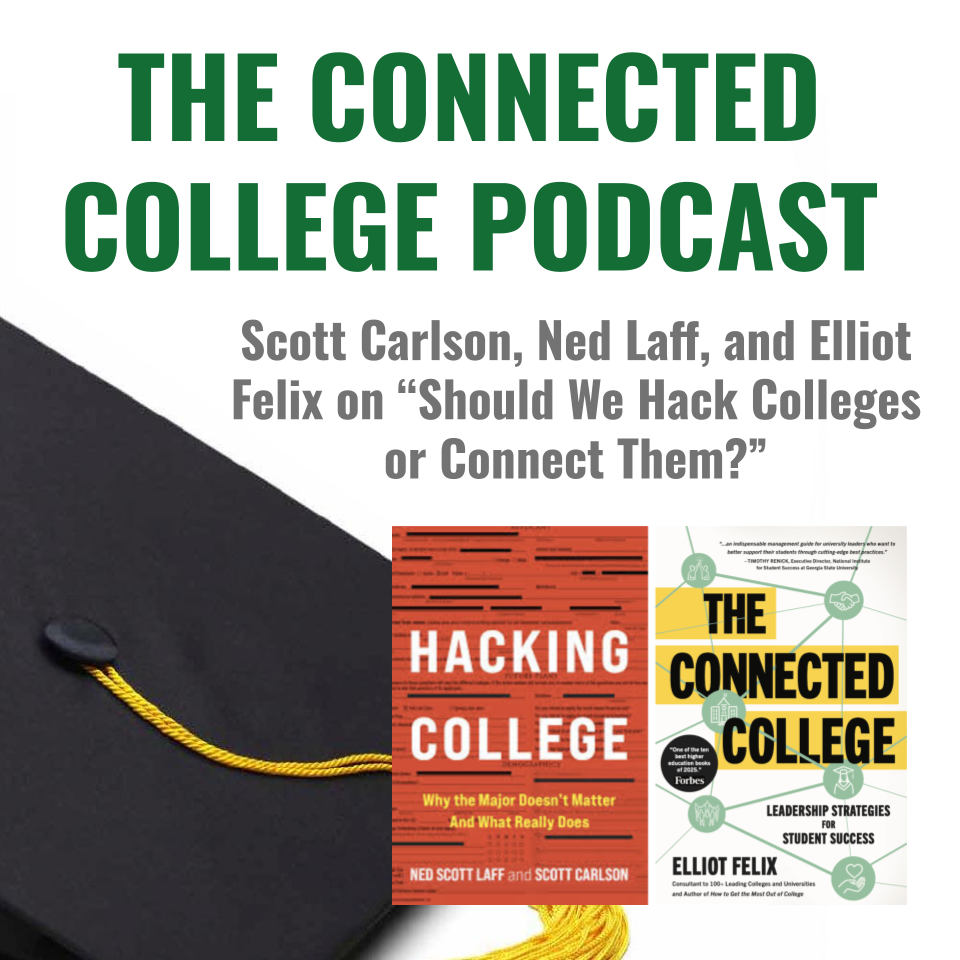
Should we hack colleges so students link their courses, clubs, and careers on their own? Or should we connect colleges with strategy that breaks down silos so that students succeed? What role do culture, policies, and technology play in how easy or hard they are to navigate? When you want to make progress, where do you start – is it top-down or bottom up? In this special episode, Elliot discusses this with Scott Carlson and Ned Laff, authors of Hacking College.
The Great Higher Ed Debate: Hacking Colleges vs. Connecting Them
In the evolving landscape of higher education, a fundamental tension has emerged: should students learn to "hack" the existing system to get what they need, or should institutions do the hard work of "connecting" their disparate parts to create a seamless experience?
In a recent special edition of The Connected College podcast, guest host Scott Carlson of The Chronicle of Higher Education sat down with strategy consultant Elliot Felix and academic innovator Ned Laff to explore these two philosophies. While their approaches differ—one focusing on top-down institutional strategy and the other on bottom-up student agency—their goal remains the same: ensuring every student has the tools to succeed in an increasingly complex world.
Redefining Student Success: Beyond the Graduation Rate
For decades, the gold standard for success in higher education was simple: did the student graduate? Today, that definition is shifting toward a more holistic view. Ned Laff argues that success should be defined by a student’s realization of self and their ability to contribute to the world—personally, civically, and professionally. It’s not just about financial gain; it’s about becoming a successful parent, partner, and community member.
Elliot Felix builds on this by identifying five key connections that drive success: connection to community, to support services, to the link between coursework and career, to internal institutional collaboration, and to external industry partners. Whether success is measured through high-level metrics like retention or through the "eye of the beholder" where students define their own path, the consensus is clear: we must support the whole student.
The Problem of the Siloed Campus
One of the greatest barriers to student success is the "siloed" nature of modern universities. Students often view the campus as a collection of disconnected pieces—the library is over here, the career center is over there, and academic advising is somewhere else entirely.
This fragmentation isn't just physical; it's operational. Different departments often use different software and report to different "bosses," making communication nearly impossible. As institutions grow more complex, the instinct is often to add more—more centers, more programs, more institutes. However, as Elliot Felix points out, most colleges lack the "subtracting muscle" to remove or combine redundant services, leaving students to navigate a labyrinth without a map.
To Hack or to Connect: Finding a Path Forward
The "hacking" philosophy, championed by Ned Laff, suggests that until institutions fix themselves, we must provide students with a "playbook" to navigate the system. This might mean "hacking" a major by declaring it just to get into specific classes or using students as mappers to find "hidden gems" of research and faculty expertise that aren't advertised in the undergraduate catalog.
On the other hand, the "connecting" philosophy focuses on institutional reform. This includes simple yet powerful exercises like "audit and mapping" where leaders visualize everything they offer on a single board. Often, this reveals obvious duplications and opportunities to co-locate services—like moving career advising into the library to increase student traffic.
Breaking Down Barriers Through Community
Surprisingly, the solution to these complex problems isn't always a massive reorganization or a multi-million dollar "digital transformation." Sometimes, it’s as simple as a barbecue.
Creating a "community of practice" allows staff and faculty doing similar work to share templates and best practices without the fear of a formal "reorg." By fostering a "coalition of the willing," institutions can begin to bridge the gap between top-down strategy and bottom-up student needs. Whether it's through a first-year seminar designed to help students map their own education or a strategic plan that finally learns to say "no" to redundant projects, the future of higher education lies in the power of connection.
Episode 113 Transcript
-
Scott: Hello, and welcome to a special edition of The Connected College. I'm Scott Carlson, a reporter for The Chronicle of Higher Education, and I'm sitting in for Elliot Felix, who's going to be a guest on his own podcast this week. Elliot, welcome to The Connected College. It's great to be here, Scott.
Elliot: I feel like I've been here all along, and now just in a new way.
Ned: Our other guest this week is Ned Laff, my co-author for Hacking College, and this week the three of us are gonna discuss hacking colleges versus connecting them. Ned, welcome to the podcast. Thanks for having me. Nice to meet you, Elliot.
Elliot: Welcome to the Connected College podcast. I'm your host, Elliot Felix. I've helped more than a hundred colleges and universities change what they offer, how they operate, and the way they're organized to enable student success. Join me for insightful interviews with higher ed innovators, sharing the stories, stats, and strategies to create better connected colleges and universities.
Scott: Okay, let's get started in this discussion. Okay, so hacking colleges versus connecting them. Before we get into all of that, let's just get a little background on where each of us are. I'm Scott Carlson. I've written for The Chronicle for a long time. You don't need to know much about me, since I'm just the guest host of this podcast. But Elliot, how did you get started in higher ed and... Tell us a little bit about your work.
Elliot: I like to say that I've been helping students since I was one. I was very involved in student government in college and in grad school, and it's interesting I did a project in grad school at MIT that- In a way foreshadows the strategy consulting I do with universities now. We got together and we did a town hall meeting, and we did a survey, and we even benchmarked our department against other departments. And then we went to the new dean and we said, MIT's amazing, And we see a few opportunities to make it better." And she was like, "This is great. You're not just coming to complain. You, you all actually have some solutions, and these all make sense. We really would love to elevate the thesis as a capstone project. We'd love to adjust our schedule grid so you can cross-enroll and take courses outside of the department a little bit more easily. We'd love to, maybe, I don't know that she said love, but we, it makes sense to increase the pay of our TAs. And so we did all that, and that's not dissimilar from the work I've been doing for the last 20-plus years working with more than 100 colleges and universities to really help them rethink what they offer, how they operate, how they're organized, and improve the spaces that students learn and live in, the services that support them, the technology systems they rely on. And I've been lucky enough to help more than a million students in the process.
Scott: And you were in school for architecture. How do you think that affects your worldview in all of this?
Elliot: It means I have a wardrobe that's all black and complicated shoes. No I think my architecture training was really great. I consider myself more of a designer than an architect, and I think that design thinking I learned in architecture has been incredibly helpful because it's the way I see the world, right? Understanding people, creating solutions together, prototyping things, trying things out. That's very much my personal ethos, and that's also what I try to teach folks in the connected college about how they can use design to solve problems and help students succeed.
Scott: So Ned, I've heard your origin story many times, but I wanna hear it again. And as I asked Elliot, I'm gonna ask you, how does your training in linguistics serve what you do today? Tell us a little bit about how you got started in all this.
Ned: The interesting thing about my training in linguistics is I was asking an interesting problem about the aesthetic use of language in poetry. And so I was always crossing borders, but as most grad students do, they have graduate assistantships. And I had an assistantship at Individual Plans to Study at the University of Illinois in Urbana-Champaign. Where at that time a student could design their own major if they could not do it under the rubric of any one of the 13 colleges at the time that existed at the University of Illinois. And what we discovered when working there is that Individual Plan to Study was very much about designing your undergraduate degree. So I'm love the background that Elliot brings because we had to learn design thinking in order to work at IPS. But what we discovered is that for every student who got admitted into Individual Plan to Study and presented their proposal to a committee of the 13 colleges to get it approved, 40 or 50 students would figure out how to design their undergraduate education underneath the rubric of a traditional major. And all of a sudden I began to realize that at root, any good undergraduate education is designed by students to, somehow resonate with their personal interests and their career interests. So there's no separation between the two. This is that relationship between hidden intellectualism we talk about in the book, and vocational purpose. And it seemed to work out very well. And when I started talking about this to conferences, everyone would say, "Yeah, but you're at the University of Illinois in Urbana-Champaign." I'm not. Can it be done on this campus? And so it led to a career where I tested this idea out on different campus settings in different climates and different communities, and every time it worked exactly the same way. That students could design their undergraduate program and come out with a fulfilling education where there was no distinction between vocational and non-vocational learning.
Scott: And so is that how you would define student success? How would you define it? 'Cause it's changed over the years, right? It used to be just we got them through graduation.
Ned: I define student success holistically. It's a combination of i've come to a better realization of myself and the world in which I'm learning and working in, and I've come to a better realization of myself with how I would like to keep contributing Either personally, civically, or through their work. And so it, it demonstrates that, yes, you can become incredibly successful financially, but yes, you can become at the same time incredibly successful as a parent, as a partner in a relationship, as a member of your community. And that's how I would like to define student success, a holistic development intellectually, ethically, marketably.
Scott: Elliott, how do you see it, and how do you think institutions that you-- maybe the institutions you work with see it or institutions just generally out there see it?
Elliot: I love Ned's definition, and I love that holistic approach because I think it is about supporting the whole student. I define student success perhaps not surprisingly in terms of connection. And in the book I talk about, five key connections. One is to a community, so you have that sense of belonging. The other is to the services that support you, and that could be counseling, it could be advising, it could be practicing a presentation, communication, writing, tutoring. The third is that connection that you feel between your coursework and a career path. So Ned, I think we have that very much in common. And then the other two connections are really enablers, right? If folks at a college or university are collaborating internally and they're partnering externally with employers, with industry, with alumni, with community groups. So that's how I define it, and It's funny to be asked this question because I ask it to everybody on the podcast. And I would say I've heard three answers, among those guests and among my clients. There's certainly the high-level metrics camp of success is retention, graduation, career placement. And that conversation is inching more toward post-grad success, which is great, salary, job placement, rising in your field. Then I think there's the second camp that has metrics that kinda lead to that not retention, but belonging, let's say. And then I think there's the third camp that is saying success is in the eye of the beholder, and it's up to students to define success on their own terms. And a great, litmus test for that, let's say you've got a co-op student and they get a job three years in from their employer. They get a full-time job- And they never graduate, they just get their dream job without it. Is that success or not is often a great litmus test for those folks.
Scott: Or you graduated into a life, a career that isn't necessarily high money-making, but is what you really wanted. I know that there's-
Elliot: Super duper fulfilling, yeah.
Scott: I was talking to an institution the former president of an institution in Maine where a lot of the students go off to do, sort of unconventional things, and they know that they're gonna get dinged for the post-grad outcomes. And it... You could say that the students are happy they're doing what they intended to do. But so that, to that last measure then, I would ask both of you so is that a cop-out or is that actually profound, success is in the eyes of the student?
Ned: I actually think it's profound, and I think it's profound in a variety of different ways. First, I believe that an undergraduate education is also in the eye of the beholder. It's how the students, it's how the students define it and how they realize what success is. And a lot of times, I think on most college campuses right now, students are having a very difficult time doing this. The vocational part, to me, is always interesting and problematic in terms of jobs, because one of the things we don't take into consideration, commitment to others. Like I, I certainly in my career could have moved up the administrative ladder, but if I moved up the administrative ladder, it would take me away from what I loved most, which was working with the students. And so yes, there was a salary sacrifice there to get this thing that salary can't account for. But the other thing that I learned also is salary depends on where you live and what you're doing and those things that make up the kind of life that you want to have around yourself. Ned: So the income level may not necessarily be as good a marker as the relationship between the way I look at my life and the way I can sit down and say, "This is a good life. I'm doing something that's meaningful to me. I'm good with others. I'm there when my community needs me. And I'm conscientious about what's around me."
Elliot: Those are such great points, and I agree, salary is a very coarse metric. And I often talk about, the goal might be to get a rewarding career, and I think there are different kinds of rewards, right? There's different kinds of fulfillment, and it might be being in service of others, it might be the salary, it might be both. And it all depends on what you value. It seems like there's a new poll every day about how much people value flexibility, right? They would take a lower salary if they had more flexibility, or they would take a lower salary if they could work from home. And so some things you can quantify or you can quantify by proxy, but I do think that, that holistic view is really critical. And I think looking at it through the eyes of the student, what they care about makes the most sense. The trouble is it's, sometimes it's hard to compare that from student to student, it's probably a both/and, where maybe you're surveying alumni about their satisfaction, career path, what have you, and then you're looking at other more standard metrics like graduation retention, salary, other post-grad outcomes.
-
Scott: Speaking of looking at things through the eyes of students, let's look at the college through the eyes of students. And something that we talk about in Hacking College, and certainly this is part of your work, Elliot, as well, is, students looking at the college as these disparate pieces on a campus that don't really talk to each other. We talk about this in chapter two of Hacking College, where, the career center is over here and the advising center is over here, and , you've got the library and their academics and their experiential learning in a completely different place and so on and so forth. And so I think the big question of this podcast, with all of us on here is hack it or connect it. And I don't know that it's an either/or, but what do you think is the way to go? What's the way forward for institutions? What's the way forward for students? Elliot, I wanna start with you, and then we'll go back and forth a little bit.
Elliot: I think hacking versus connecting depends on your role or your perspective and your timeframe. Because I think if we had better connected colleges, students wouldn't have to hack them, right? That's my thesis coming into this conversation. But it would be incredibly unfair for- millions of students to wait for us to get the fix. And I think in the meantime, we should give them a playbook, right? So we should make college easier to navigate and better connected. But in the, at the same time, we should show them how to understand themselves, Ned, as you're saying and how to connect their coursework to a career. But at the same time, you know, we can connect career and academic advising. One of my clients, St. John Fisher, does that, and they also do the third thing, which is they put it in the library. when they put integrated career and academic advising in the library, the traffic went way up. Which is another kind of connection is that co-location because the other reason colleges need to be better connected is they do amazing things, but unfortunately a lot of students don't know about those amazing things, especially if they don't have the roadmap, if they don't have the social capital. And so the better connected they are the more they can capitalize on those opportunities.
Scott: Ned, what do you think?
Ned: And Elliot, we are so on the same page. Now while I did this quite underground on most campuses I ran the offices that I created as if they were information commons, libraries. But what I also was able to do on some campuses is I had general education under me. I actually brought career services in. I brought service learning into my, into the office space, and I brought in the program, the interdisciplinary studies program, where somebody could build their own major, right? And then I opened the door. I don't know how I did this, but I convinced the provost to let a faculty member get course release time to work in the center. Because if they could understand what was going on in the center, then they could take it back to their department. And so we kept, we wanted to rotate this through. And I have to tell you, I started out with one of the people on my campus who was the biggest detractor of everything I wanted to get done, and that faculty member became the biggest proponent on campus of everything we were trying to get done. And so with everything that you outlined, yes If we had connected colleges, and silos that were porous, and faculty and departments and colleges that would realize that if they got into a dialogic, they could create an educational environment where every department wins because they're getting information coming from places that they would not normally have. Students would win because they would see the incredible opportunities that are available on a college campus if they could put the pieces together. And what I found is that in order to do this, it doesn't take... It's not, we're not talking about money. We're literally talking about can't we all just work together, right? We run the college, right? On any campus, we run the college. We could create whatever kinds of rules we want to make this work, and what happens is everybody benefits. One of my favorite stories about connectedness when I was working in individual plans of study, I had a student who was interested in working on the commodities exchange. So one of our pedagogies was to have students identify faculty by their field specialties. So the student identified two faculty members who were both working on research on the commodities exchange. One of them happened to be on one side of campus which was the economics department in McKinley Hall, which was the business school, and she could get on the shuttle and go to the other side of campus where there was a faculty member working on the commodities exchange who was in ag economics. And the cool thing about it was the student connected the two faculty members because they had never crossed paths, ever. They were on different colleges, different parts of the campus, doing different research, and they were able to start to do joint things together. So there's all these synergies. There's myriad of synergies that exist on campuses, and if we let those loose, campuses would be so vibrant. Just so vibrant.
-
Scott: But what gets in the way? Is it rear guard stuff? Is it people just covering their turf? What i- what's the deal?
Elliot: I think it's some of that, but I think it's also that colleges have become more complicated and more complex, often for good reasons or understandable reasons. I think as students' needs change the instinctual response is to add something. Add a center, add a program, add an institute. And the habit or the skill or the muscle that most institutions haven't really built is the subtracting muscle.
Scott: But isn't that addition thing, though, isn't that part of the whole power coveting that happens on a campus? It's "I'm gonna build a thing that's gonna be my thing," instead of, "I'm gonna work with this thing that already exists on campus, and we're gonna build something together to make something bigger."
Elliot: There's certainly people in the world that wanna accumulate more power and influence and have their own turf, but I think more, more frequently it's just, it's the sort of default organizational norms, behaviors, habits that- Yes that- Yes ... that kick in. And I think I'm... So I'm advocating that we don't let a few bad apples spoil the bunch because I think most of the apples wanna work together, they just don't know that the other apples exist. Or they report to different apple bosses. That's probably one step too far for that analogy, but Yes.
Ned: And at the same time, at the same time that this norm behavior and this normed understanding is taking place, the colleges and universities themselves are working against this. This is when you see this thing where we're going to create an interdisciplinary center, and many times these interdisciplinary centers, they're not connected with colleges. They're not connected with courses being offered, but they are connected with the fact that we're dealing with wicked problems. Wicked problems demand a dialogic across the disciplines, and so they put them together in these centers. So on one hand, we have these centers which actually mirror what we want students to be doing in their undergraduate education, but then we put these students into a system that is siloed out, and sometimes we create those silos so they have unbreakable boundaries. And so there's this craziness taking place on college campuses, and here's an interesting thing, and I tested it a few weeks ago when I was talking with one of the members of the the Hacking College Learning Community. He's at Florida State. I asked him to pull up the undergraduate side of campus and pull up any department. So when he pulled up the department, it didn't really list who the faculty were and what they were up to. So then I asked him to pull up the grad side of the webpage, and up comes this incredible stories of the interdisciplinary work that these faculty are doing. Where do students get introduced to this? Certainly not during orientation as a first year. They don't get introduced to it in advising because advising is dependent on the tools they're told to look at, and those tools are at the undergraduate level. So this whole interaction that could be taking place, it's there and it's almost hidden behind a veil that doesn't allow people to just start putting things together.
Scott: Yeah. If you think of something to what Elliot was saying too, in the sense that it's this amalgamized just conglomeration of all these different pieces, and that makes it difficult for the different pieces to talk to each other. Particularly in this tech age where a lot of people are working in these individual pieces of software that, that themselves might not talk to each other, so there's the segmentation on the operational level, and then the segmentation in the hierarchy, and the segmentation in terms of what do you do and does that really connect to what I do, and then the lack of communication that's across campus. So how do you say that we have to deal with this? How do we break down some of these barriers? What's the best way?
-
Elliot: One simple exercise that I do simple but powerful if I'm working with a, an institution on a new service model or a new staffing model or an academic plan, just the simple exercise of listing what you do now on a Post-it, each thing on a Post-it. Maybe you color-coded them. Maybe you put them on a Miro board, right? Or you put them in the room on a whiteboard. I've done hundreds of these things, and I have yet to see a single workshop where two things don't happen. The first is some leader will step back, they'll see the whole thing maybe for the first time, and they'll say, "This is too much." The second thing that happens is they'll say, "This thing and this thing seem really similar. Can we combine these?" Or, workshop participants will do the same thing. So I think a very simple exercise is a Audit and map what you've got because even if you make no changes, which hopefully you would, even if you make no changes, at least now you have the kind of awareness of the big picture, and it's not hidden as you're saying, Ned. So I think a very simple and effective step is just understanding what you have and using that to inform decisions about what might be missing, what could be combined, what could be sunset.
Scott: Is part of the challenge there just to bring up a quick question and a hard question to answer, is part of the challenge there that if you start to see where some of these connections are, if you start to see where there might be duplication within the organization, then we start to have tough conversations about why do we have people in both of these organizations and what do we do with those people?
Elliot: It's way harder to manage to a no than to a yes, right? If you're in charge, it's way easier to say to someone, "Yes, you can do the thing you wanna do." It's way harder to say, "No, actually we have something like that over here. You can work with them," or "I'm sorry, but this is a lower priority than this, so we can't do that anymore. We can't continue to fund that." I think those are really tough conversations to have but we need to be having them.
Scott: Ned, what do you think?
Ned: Elliot, you mentioned something really interesting, audit and mapping, because that's what we have students do when they're going through this field of study process. We teach them how to look at the breadth of a campus in areas that they normally wouldn't explore and then they begin to find things that are actually hidden gems for what they need, and then they start mapping this out into what we basically call field of study. So in a sense, they're mirroring what the faculty are already doing. On the other hand, the power of these centers, it has to do with funding and it also has to do with generating funding, generating grants and bringing it, bringing in research dollars and that's a powerful influence on campus. But I think, I really think the conversations can take place in those dreaded things called administration talking with faculty senate, that we can create collaborative ventures that allow multiple things to happen on a college campus. One of it, certainly to allow all these- Interesting people who are doing this crazy research that crosses boundaries to work together, but also to help students be able to see how different areas of learning can come together and open up possibilities for them that they may never seen. And I think this is, it's kinda let's have a softball game and a barbecue after, right? And then we'll, let's just talk this through as if we're just in the park after a game and just talking about possibilities and saying, "Yes, we can make this happen." It's not that it's gonna cost money, it's going to cost changing our view of how we can integrate ourselves better.
Scott: Ned, real quick. You and I have talked about, in the past about the using students to map- Yes ... what- what's happening on campus and then make the connections through that. Yes. That's one way that, that these campuses could start to start to connect you know, students with the various hidden jobs even that are on the campus itself. That can be the driver for how this happens.
Ned: Way back, this is so 20th century I'm working at a living learning center, unit one at the University of Illinois in Urbana, and we had all 650 students survey everybody on campus to create this thing called HELP, Higher Education Learning Possibilities. Okay, so the students put it together and then grants and contracts got a look at it, and then grants and - contracts took it from us, which is, was okay, right? And created the IRIS, Illinois Research Interest Survey, and all of a sudden now different people are coming together, "Hey, you have an interest here. This person has an interest here. Do you guys wanna put together a grant to do this?" The two can work together. We just have to believe that it can. Yeah. And there's great synergies that come from it.
Elliot: Yeah, I love the idea of students as connectors and mappers. And I also just wanna second something you said earlier, Ned, that it's, we can create the rules. It's up to us to create the rules, and I think part of the reason why higher ed adapts by adding and is accretive and I think sometimes slow as a result of it, are the policies. And I think the policies slow things down, and then it's a negative feedback loop because the slower things get, the more people wanna do things on their own, right? Yes. And then You add more stuff and, "Oh, I need my own tool 'cause it's gonna take me a year for so and so to approve this other thing," or, "It's gonna take too long for us to integrate or collaborate with these other groups." So at the risk of introducing another analogy one of the things I quote in the book, Jason Fried has this idea that policy is organizational scar tissue. It's in effect, it's like an overreaction to usually what's an isolated problem. Somebody doesn't submit their expense report on time, and so now all of a sudden you have to submit it within a week or you don't get reimbursed, and then everyone's stressed out, and it becomes a whole big thing. And so A policy audit is another thing you can do and just see w- can we reduce some layers of this bureaucracy? Which of these rules do we really need? What's the worst thing that could happen if we didn't have this rule? Yeah. And cut through some of it that way to speed things up, because I think the problem with policy is it begets more policy.
Ned: And more rules.
Elliot: And more rules.
-
Scott: I wanna return to something that Ned had said quickly, and maybe end on this, which is, y- let's have a barbecue. I- which I think actually is a profound statement in a way, because I think what we're trying to do through the creation of colleges and universities and through campuses in particular, the in-person process, is this creation of community. And so I wonder if that's something, how you see that trending in terms of in terms of bowling alone on campus. Is that happening right now, and how is that affecting the connectedness?
Elliot: I think a lot of times people see and hear the problems we're talking about and they think, "Oh, we need to reorganize, and it needs to be this big thing, and we're gonna call it the blah blah blah transformation," which is, by the way, the worst thing you can do, because then everybody's scared of it. Never call it a transformation. And sometimes you don't need a reorg you just need a barbecue, right? Or you just need a community of practice. I've seen great examples where like at National University, they have an analytics community of practice. They didn't go through this huge thing of everybody who does analytics now needs to report to this... they're just like, "Hey, what if the people that are doing similar stuff got together on a regular basis and talked to each other and used the same templates and shared best practices and had a chance to showcase the awesome stuff they're doing?" Sometimes it doesn't, it doesn't take a formal boiling of the ocean. It can be a barbecue or a beer or a community of practice.
Ned: Yeah, it could be a de-organization. Break down some of the silos. The silos are actually mythic. Here's a action that I give students to hack. Oh, you can't take this, these courses if you're not a major in this department. Okay, declare the major, take the courses, and then drop the major. I love it. It's nuts. It's totally nuts, right? It doesn't make any sense. Or colleges will say, let's create formal badges, right? But when you think about it, if you just think in terms of we don't have to create formal badges. They, we have so many combinations of things that are profound when you put four or five courses together, right? And you can keep turning this kaleidoscope and keep coming up with new things that affect students and can affect the way faculty interact. Just let's do it instead of trying to come up with an organizational structure, put it through curriculum committee, which, what, could take a year and a half or more to get it done. Why do that when we can be a major school or a small school can be incredibly agile in doing these kinds of things if they know who their people are, know what they're involved in, seeing how they interact and create synergies, and then let's let it roll and see what comes up.
Elliot: I love that, and I just have to shout out two, two of my favorite teachers growing up had these great examples of your declare the major, then undeclare it. One taught an art class you know, in a basically a room that was like a shop and it had a table saw, and the state or whoever came in and they're like, "You need to have a guard on the table saw." And he's the guard makes the saw less safe 'cause then you can't see the blade." And the, there was this whole back and forth, and so finally he just bolted the guard on the side of the saw, and he's like- Yep ... my table saw has a guard on it. And then my, another English professor got reprimanded for not wearing a tie, so then he just... 'Cause he always wore pocket T-shirts, so then he just clipped a clip-on tie to the pocket of the T-shirt. And I think there are- Excellent ... there are ways around these rules when you wanna work on behalf of students. And, Yeah ... and then eventually- Yeah ... I think the, the best case scenario is people see the rules that make sense and the ones that don't, and the bottom up, gets met by the top down change.
Scott: Yeah, that's absolutely what we're talking about in our book. The whole, the creation of the whole desire path and using hacking to change the system. So I think that resonates very much. So Ned said let's roll, right? So if we wanna roll- To our barbecue, to changing the connected college. It goes from the hacked college to the connected college, or it's back and forth between the two. Where do you start? Where is the one place you think that you can make a wedge and then hack it, your way in and then create this connected college? Where would you do it? Elliot, start with you.
Elliot: I think the root of the silos is in strategy. Every college or university has a strategic plan, but very few have an actual strategy that focuses them. And it's of course, , it's easier said than done. It's much easier to create a strategy that focuses you where you're making choices and you're saying, "We're gonna do this. We're not gonna do this," when you're at the department level versus when you're at a 20, 50, 100,000 student university. But I think that focus is really critical because that's how you, A, differentiate yourself, and B, once you're differentiated, then you can actually collaborate, with companies, with peer institutions instead of competing for the same students or the same resources. And that same focus helps at the departmental level because then, or the school level or the college level or the program level, because instead of competing for the resources, you can actually collaborate. So my wish for universities is they really flex that strategy muscle and they make choices, right? Like Roger Martin talks about strategy is where to play and how to win. And not enough colleges or universities can answer that question. And so I think if we're more strategic, if we're more focused, if we're more differentiated, then people know what to say yes to and what to say no to. They're not competing, they're collaborating. And then we're not propagating silos, we're breaking them down.
Ned: My wedge would be to take over either the orientation or sometimes called the mastering college course or even introduction to composition and run it all around this question for students. Your goal this semester is to design your undergraduate education and begin with introducing them to the field of study concept and introducing them, regardless of the size of their college, to how marvelous- An opportunity they have with all the hidden resources, including faculty identified as field of study and all the other people who make up this incredible thing called the learning environment. And finish that course with here's my proposal, my tentative proposal design for how I wanna put my undergraduate education together."
Elliot: You know what I just realized is we've just our answers mirror the perspectives of our respective books, right? Because- Yes ... you gave the bottom up, I'm gonna hack it through the first year experience, first year seminar, and I gave the top-down, we need a new strategy. Which I'm I, I'm- And- ... I'm getting a kick out of ... what I'm hoping one of the things I'm hoping is that when the top-down sees what the difference is and how students engage and perform, then they begin to say, "Hey, wait, there's something going on here. Maybe we ought to take a look," right? But I'm really big on students can drive the change if somebody shows them how.
Scott: And I think you both had said something profound in the sense that when we talk about, like, how do these, some of these colleges take on the field of study method, or how do they start hacking themselves in a sense, we always talk about, you find the coalition of the willing. You find these few people who believe in this thing. They wanna offer students something different. But then they have support from the top to do this different thing, so they take over those orientation programs or first year experience programs. And so it is this connection between top and bottom, I think, that makes things very successful at an institution. This is a good place to end the discussion of the hacked college versus the connected college. Elliot Felix, thank you so much for letting me be the guest host on your own podcast.
Elliot: My pleasure, Scott Carlson. Great to have the tables turned.
Scott: And Ned, thanks so much for being on the podcast and letting me ask questions of you for a change.
Ned: Scott, thanks for doing this. Thanks for connecting me with Elliot. And Elliot, I have to tell you, we love your book. We see so much synergy between what we're doing and what you're doing. Thanks so much. I feel the same way, and I'm really in awe of all your impact in students and out in the world.
Elliot Felix: Thanks for listening to the Connected College podcast. Go to Elliot felix.com for more information about my book, the Connected College articles I've written and talks I've given. There's also tools you can download information on upcoming events and information on booking me to speak at your institution or organization. Please support the podcast by rating it and reviewing it wherever you're listening. Let's create connected colleges where all students succeed.