
Episode 107: Sasha Thackaberry-Voinovich on AI as a Practice to Enable Student Success
Listen On


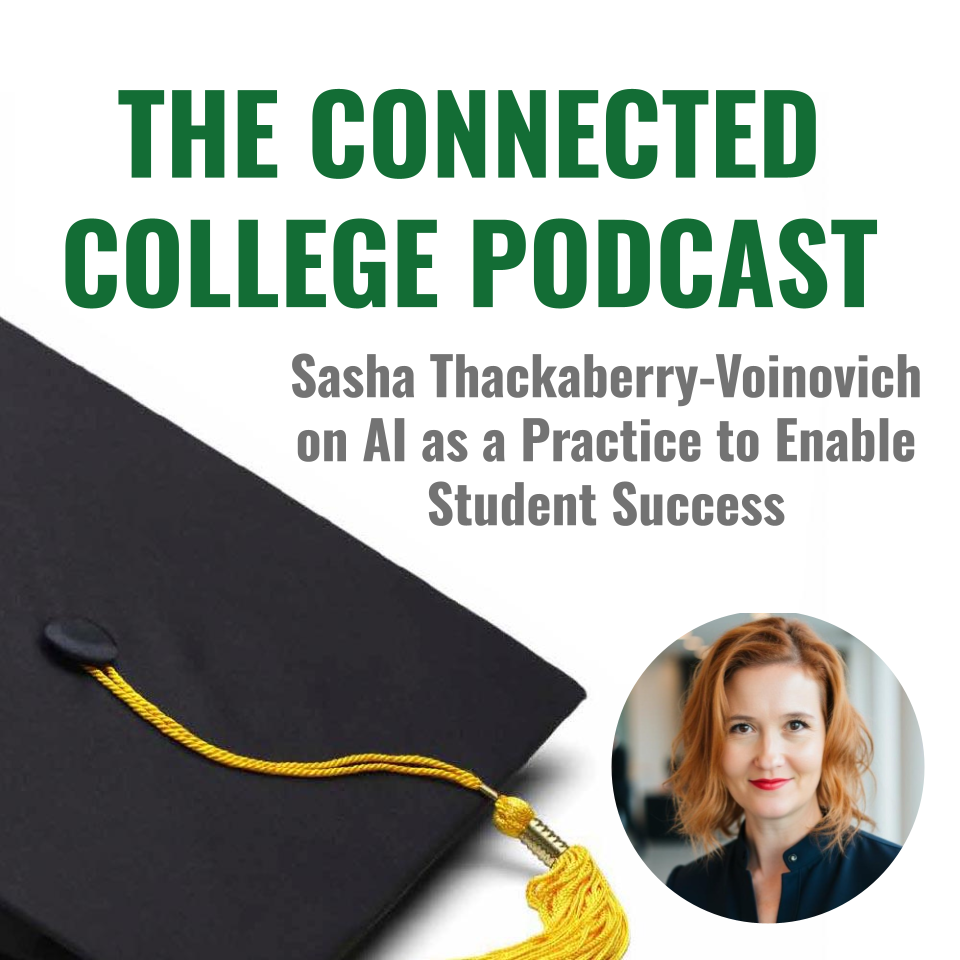
How can you make AI a practice in your institution so that it's not just something you use but something you are? How can you embed it in your curriculum, culture, and operations? How does doing this enable responsiveness, personalization, standardization, scalability, and more. We discuss these questions and more with Sasha Thackaberry-Voinovich, Co-Founder and President of Newstate University.
The traditional model of higher education is facing a reckoning. For decades, institutions have layered new technologies over old habits, creating a "patchwork" system that often prioritizes administrative complexity over the student experience. But what happens when you strip away the legacy debt and build a university from the ground up using Artificial Intelligence not just as a tool, but as a foundational practice?
Sasha Berry Voinovich, president and co-founder of New State University, is doing exactly that. In a recent conversation on the Connected College podcast, she shared how her "AI-first" institution is redesigning the system to eliminate friction, reduce costs, and prepare students for a world where knowledge work is being fundamentally transformed.
Breaking the Habit: Why Systems Need Redesign, Not Bandaids
Most colleges operate on "habits"—ingrained human and technological systems that often get in their own way. Voinovich argues that many modern innovations in student success are actually just workarounds for structural friction. For example, student success coaching often focuses on helping a student navigate a confusing calendar or a fragmented tech stack.
Instead of putting bandaids on a broken system, New State University focuses on redesigning the underlying structure. By questioning legacy assumptions, they’ve created a "utility university" designed for the adult learner who needs a compelling choice and an expedited path to the finish line.
Personalization Within Standardization
A common fear is that automation leads to a cold, robotic experience. However, Voinovich suggests a different framework: personalization within standardization. By constraining choices upfront—such as offering streamlined, stackable paths rather than hundreds of confusing electives—the institution can focus its energy on a high-quality, responsive experience.
This standardization allows the university to leverage a "no-code" tech stack that is endlessly scalable. Whether it’s using AI assistants in HubSpot to build workflows or native AI coaches within the Learning Management System (LMS), the technology works behind the scenes to ensure that support is on-demand and progress is competency-based.
AI as a Practice: The Human Mindscape
The biggest challenge in adopting AI isn't the software; it’s the humans. To move at the "speed of 2026," staff and students must engage in intentional unlearning. This means letting go of the idea that work must be "precious" or that a process used yesterday is the best one for today.
At New State University, the team operates in "hyper-agile" mode, reprioritizing tasks twice a week and abandoning tools that are no longer effective. This level of agility requires a culture of "egolessness" and a commitment to documenting everything—creating checklists that eventually serve as instructions for future AI agents.
The Future: From Knowledge Work to Choreography
As we move toward the end of the "beginning times" of AI, the nature of work is shifting. Voinovich predicts a bifurcation in higher education: traditional colleges that offer an "experience" for a subset of the population, and utility-focused institutions that provide the specific skills needed for a changing economy.
In this new era, professionals will act as "choreographers," designing the show and directing AI and robotics to execute the tasks. To have choices in this future, students must first have the skills to adapt.
Episode 107 Transcript
-
Sasha: If you need a personalized guide to navigate the system of becoming and remaining a student, not the learning part. Not the learning part, just navigating the system. Your system's wrong. Yeah. Stop trying to put bandaids on it. Redesign the system. Yeah. And I say that and it sounds a little flippant, but it's 100% possible today. 20 years ago, this would've been so much harder. 10 years ago it was so much harder.
Sasha: Higher ed has to look structurally at their systems, their technology systems, their human systems, their habits. Institutions have habits and they get in their own way. We need to solve the underlying structure so that you can actually move at the speed of 2026.
Elliot: That was Sasha Berry Voinovich, president and co-founder of New State University. We had a great conversation about AI as a practice, how they've embedded it, not only a curriculum, but in the operations and culture of their startup university. In the connected college, I talk a lot about the difference between something you do and something you are, and this was a great example. We dive into how new state. Is all about combining standardization and personalization, how they're organized to be responsive to student and employer needs, and the new opportunities that AI affords and more having started and scaled a higher ed consultancy, so much of this episode really resonated with me and we found some interesting parallels. I think it's gonna resonate with you as well. Let's dive in. Welcome to the Connected College podcast. I'm your host, Elliot. Felix. I've helped more than a hundred colleges and universities change what they offer, how they operate, and the way they're organized to enable student success. Join me for insightful interviews with higher ed innovators, sharing the stories, stats, and strategies to create better connected colleges and universities.
Elliot: Welcome Sasha. I'm so excited for our conversation about AI as a practice.
Sasha: Oh, thank you so much for having me. It's so exciting what we can do in this day and age with ai. It's it's almost a miracle. Yeah. It is a practice though.
Elliot: It is, and I think it's often thought of in these separate silos, people are applying it. Externally, they're thinking about it as content or a skill. And then they're using it in pockets internally in their daily operations, but they're not integrating it my litmus test is is it something you do or is it something you are, and it feels like for you all, like AI is something you are. So I'm excited to dive into that.
Sasha: Yes. Yes, absolutely. And I think one of the things that's maybe the least sexy approach to ai, but the one that I get the most excited about is ai, operationally what you can do with it, that's not even visible. That makes scale possible that makes quality possible, that makes on demand support possible. But the biggest, I think the biggest difference and the biggest struggle we're gonna have is actually not the technology, is the humans. Yeah. We have to reimagine ourselves. And that's actually a lot, that's a lot harder than a soundbite.
Elliot: I'm sure it is. And before we dive into AI in your operations and the culture change around people. Let's talk about who we is in, in that sentence or who we are, I guess more less the royal and more and more precise. So yeah, tell us a little bit about how you got started and what you're up to today.
Sasha: Fantastic. Yeah. I, along with a couple of other intrepid amazing people founded a new university. So it's New State University and we are an AI first university, so that means that we actually teach applied AI skills throughout our curriculum. But we also operate on ai. And what that does is that allows us to dramatically reduce the cost of education so someone can literally just pay for it out of pocket. We have the technology to do this in 2026 and there's really no reason why we can't. We are coming up on some pretty big economic changes and societal changes, and people need a way. To get on top of that without having a ton of debt and with having a deep enough learning experience that it can become a habit, that it can become a practice, that they can become the person of great value at their organization or start their own. So we're super passionate about the middle class and making sure we have one and that AI is gonna be the ingredient in that. Not one of, but the.
Elliot: And tell us a little bit about what are the programs. Degrees, certificates, grad, undergrad. Yes. What are the offerings at New State? We'll go from the we to the what?
Sasha: Yes, exactly. So we have both non-credit and four credit offerings. So we have everything from a single micro course all the way through an MBA, and everything is fully stackable. There is no such thing as electives in our universe. So you pick a path and then you are on that path. You cannot divert. And it is very streamlined and simple. I always reflect back on how it is so hard to make a decision about what to make for dinner. At the end of the day adult learners do not need more choices. They need a compelling choice, and then a way to expedite getting that thing done, right? And so that's what we do. We teach in ai, obviously applied ai, though not computer science business. Customer experience, which includes, everything from customer journey mapping to B2B and B2C sales project management and product management. And again, it's all like AI integrated. We think these are some of the crucial skills of the future. We're also intentionally not doing things. So what we're not doing is getting into healthcare. People do that very well. We're not getting into computer science. We're not a research institution. We are not born to serve a traditional 18-year-old who wants an on-campus experience. We do not have a football stadium. And there, there is no smoothie bar. We are what people need to do the job. We are a utility university.
Elliot: It's awesome And I think that, the idea that you're focusing on these skills and capabilities. And then you're applying them in these different ways, product management, project management customer experience, I think is great. You're general you're general and specific all at the same time and in a really practical applied and focused way. And I wonder how, given that. Focus and application and your thoughts about access. How do you define student success?
Sasha: This is so interesting 'cause I have had I think, a somewhat unique experience in that I have worked at a variety of different institutions that serve very different types of students in very different ways. Everything from a community college to, research institutions and I think student success is a combination of making sure individuals not only can. Can have access to the things that they need to be successful, that they are matched to a goal that is achievable for them, and that really. We do great things with support in higher ed. The thing we do typically pretty poorly is reduction of friction, right? So , you can get help, but generally speaking, you have to navigate a system to do that. You can have assistance filling out your application, but you need to contact a person. I ran into this even trying to get my daughter registered for. A class at a dual enrollment class at a community college. It got to the point where I literally had to call a friend who is an administrator at that institution to get her paperwork pushed through. I was waiting for weeks so at New State University, we were like that is a barrier to student success. Get someone started, let them start. And so we created a system where literally you can go to our website. You can apply hypothetically, apply for a bachelor's degree. You get accepted into that program today and you start classes today, right? So it's fully competency based. It is on demand university, but not low quality. It is a rigorous program is project based. But student success means getting rid of the friction. We always talk about barriers. But we don't talk about how that works from a functional user perspective. Like, how many people do we lose simply because we didn't get someone an answer.
Elliot: I love the idea that success is getting to your goal without friction. And I think it's a really astute observation. I think there's. Good friction. And there's bad friction. Good friction is like a stretch assignment. Yep. And opportunities for growth and recognizing that hard stuff is good for you. But there's a lot of bad friction in higher ed. And if you think about where there's been a lot of innovation recently, a lot of that is just workarounds for structural friction. It's student success coaching, right? A lot of what they're doing is getting people oriented to the calendar, the curriculum, the tech stack, whatever it might be. Yeah. And instead of changing calendar, they're doing really important work. But we're in a little, in, in some ways, we're like treating the symptom, not the root cause.
-
Sasha: I literally could not agree more. If you need a personalized guide to navigate the system of becoming and remaining a student, not the learning part. Not the learning part, just navigating the system. Your system's wrong. Yeah. Stop trying to put bandaids on it. Redesign the system. Yeah. And I say that and it sounds a little flippant, but it's 100% possible today. 20 years ago, this would've been so much harder. 10 years ago it was so much harder. Higher ed has to look structurally at their systems, their technology systems, their human systems, their habits. Institutions have habits and they get in their own way. So much of this stuff, like the design of how we support and enable students. It's not rocket science. It's doable. The problem is the structures that have grown up at most institutions don't allow for it. They could, but they don't. And then you know these, and you get into a place and it's not, I don't necessarily fault institutions, they are trying to solve the problem for the student. But we need to solve the underlying structure so that you can actually move at the speed of 2026.
Elliot: It's such a good point. And it seems like you're able to capitalize on two structural shifts. One is. As a new institution, you can question, let go challenge legacy institutions. Assumptions and so forth. And then the other is your adoption of AI as a practice integral to how not just what you teach, but how you operate. I'd love to pull on that thread a little bit. Like you mentioned 20 years ago, it would be a lot harder what are you doing differently? What are the things, where you looked at it and you were like, we don't just have to do it. The way we've always done it, right? Yeah. And how did technology enable that?
Sasha: I wanna start actually with our tech stack. So one of the things that we did very intentionally was, start it from the perspective of. What does it need to do? Not what category does it fit into, or if it even necessarily was built to do the thing that we're gonna be using it for. What we wanna do is, okay, this is a function that needs to be completed. What technology can get us there? Or requirements? Were endlessly scalable, so we wanted something that was in the market. Full SaaS. No, no code. I cannot say that enough. No code. So anybody can change our integrations if they need to. And we did have, like a year ago, we had some limitations. There were things we literally could not build because they didn't have outta the box integrations and I didn't go hire a developer. Those things are possible now, i'm waiting another month to do some things in terms of some APIs because I know there it is just gonna, it's just gonna get better. It'll be easier for me to do certain things a month from now. So I'm not gonna do those things until a month from now. So we looked at what functionally has to be done. You have to have student records, right? You have to be able to progress a student along their path. You have to be able to track their performance. You want them to have a beautiful learning experience. You don't want them to experience friction. You need to be able to track their data for accreditation purposes. And so we picked a tech stack that is not a typical higher ed tech stack at all, and are able to configure it for what we need it to do. Part of that is because of how we chose to think through the learning experience. It is so much more efficient to be able to have a single path for students. Like having a single path for students. I looked at one of the major online institutions had I think it was 24, 224 elective options, and students needed 14, so they had to pick 14 from these like 230 odd courses. Why would you even have the others? Adult learners are, don't typically come to wander and explore, right? And so what we're able to do is go ask AI how to help us with that.
Sasha: There's two primary ways in which we're using ai. One is AI within the tech stack tools that we've already selected, or rather within the tech stack systems that we've selected. So for example, we use HubSpot. There's an AI assistant right in HubSpot that can help you build things. It can literally build workflows for you. Now you can tell it what to workflow and it'll do that. And then there's also like native tools, like in our, in the LMS we use, it has a native AI coach. Part of the reason that we picked that tool, right? We don't have to do a plugin. Nobody has to worry about data flows. It's just in the system. And then secondarily is what? Technology did we pick? What are we using outside to get the assets to hook things up? It's so wild. We're now building agents and Claude, and three weeks ago we couldn't do that. I feel like I'm like madly tinkering because the first thing we do is how can we automate this? How can it be intelligent? How can AI do this for us? Can AI even hook it up? It's talking to our systems. It was like sending LinkedIn emails for me the other day, customizing them for every single person, but from you, right? And so if we're able to leverage it, then we can teach it. This stuff is moving so fast. You still have to have these like basic competencies. You have to know the underlying content and information. We literally, you would fall over if you knew the resources that we've put into this. But if you make AI a habit, if you look at AI as a practice, it changes everything. You don't have to think, oh, how can I incrementally do this thing better? No, imagine further. If I could do this thing, I would want it to seamlessly post across all of my social channels and be able to respond to every single reply. But I would wanna use this customized LM as, an example of tone and yada. It's, you can just do it now. You can just do it now. But I'd hazard to guess that 90% of institutions and organizations aren't.
Elliot: Yeah, it's interesting like the idea of the tech stack for scale with embedded automation and the kind of the curricular architecture as the two kind of primary targets makes a lot of sense. And I think, I'm just thinking about, if you can constrain the choices upfront everything that follows from them. Gets a lot easier. I had a similar and analogous experience just, running years ago running a boutique higher ed consultancy and wanting to productize our services. And the realization, first you have to think about what drives variation. And a lot of it was internal. Internally driven oh, let's take a whole new approach to this. Everybody, everybody's a special snowflake. But then the other is just understanding, variation among your clients. And the way we ultimately like cracked that nut was just defining specific service offerings with a specific path, not unlike a curricular path. But, figuring out what drives variation in your business. And then how you can confine or constrain that in productive ways, I think just makes a ton of sense
-
Sasha: and people will have a personalized experience regardless. Sasha: So what we're not is building software, right? I think it's hard to do that and build an institution at the same time. It's not a core competency of ours, but if you build the learning experience to be compelling, if you keep universal design for learning in mind, our learning model lets people proceed entirely at their own pace. And if they have the competencies, they can move forward. W fairly quickly. The projects are rigorous. We have user tested them. We've gotten a lot of feedback on it, but that's the personalization. Yeah. This is where there's personalization inside of standardization because when someone is going through something that is as deep as a degree or as a certificate, something that takes several months, they want a commonality with other students. They want that. Okay, we've all experienced these same things. The structure was the same. Hey, how did you feel about this? Or did you see that component? Or how did you address this on your project? If you don't have commonality, it's harder to build community, right? And at the end of the day, that is what is going to make it personal for people. So if you have this consistency, you have. Very specific paths. You don't allow deviation, but you allow personalized applic personalized experience application. Yeah. Yes. Within it. Within it, right? Yeah. And then you have this commonality.
Elliot: Yeah. Our experience was analogous because, you know that the personalization within standardization, like once we defined a process and a path to deliver. A consulting service, strategic planning, whatever it was, each client's experience might be different based on their culture, right? The governance structure, the process, what they'd done before, but the path, the path is defined and then once you have it defined, it's just way easier to orient people, to onboard people, to share information and data across projects and programs. I get it, in a visceral way. And I would love to hear like you've defined these paths, you've created this scalable tech stack. What are some of your early results and insights from your students and from your staff?
Sasha: So I'm gonna start with the students. It should always start with the students, as you should. Yeah. We've gotten some really great feedback, and by great feedback, I mean it's not always balloons and sunshine, right? We got some of the feedback that we had on our use of avatars at the beginning was that they were like a little wooden. There was a little too much of 'em. And we were able to immediately get into the courses and make adaptations. We have found that it's so fascinating to me as a student, I would jump to the test, like that's my personality. I would wanna know, am I ready to move forward to the project? So I would jump to the desk. It seems like most people aren't doing that. A lot of people are progressing through very much as a learning path, varying their speed through it. But we have people who are like, I really need more videos. I would love more videos. And then there are other people who are literally reading the transcripts of videos and podcasts, which. Would never occur to me as a preference. Which is hysterical because it totally should occur to me as a preference. But one of the amazing things about AI now is you can transform the same type of content into a variety of media. With relative ease and speed. And we're able to do that and literally iterate in real time. When someone asks a question, we have a feedback form right in the course. It gets sent right to us and we can see, what are people experiencing. The other thing is people wanna be part of something, like we wanted to build something really special and people. I think really feel like it's something special, which is great. We wanna be the Trader Joe's of higher ed. Like I want to have really fantastic brie and inexpensive, but well done wine. I say wine I don't even drink, so I'm not really sure what a well done wine is. Probably not a saying, but I want it to be something where people identify with it, they wanna hold the bag, they know they're getting a good value and a good ROI. It is what they want.
-
Sasha: For our team, oh my gosh. We went from doing two week sprints to, that was too long, like two week sprints. It was too long in between deadlines. So then we went to we reprioritize twice a week. Wednesdays and Saturdays we reprioritize where are we? What do we need to knock down? Do we need to change something? So we call it hyper agile. That's probably not a real term. But what we do is because something like a new tool can drop or one of us learns a new way of doing something, and then we have to teach it to the others. It is without a doubt, the most fun I have had working in. I think my adult life, because it's literally discovery every single day and not everything is great, right? So I discovered one thing. I was super, super excited about the use of this one bot, and then it just got progressively less impressive. And so you abandon things, right? But you abandon them fast. You try a new thing. If you had asked me five years ago, would you consider changing media production tools like every two months? I would've laughed. I would've said you were insane. Like you need consistency, you need to be able to have source files and to, and now, absolutely. We don't even buy year long subscriptions to anything anymore. Because two months from now we could be using different tools. When we started this thing has only existed for we launched with students in July. We started building courses last February in the curriculum. And we've changed tools so many times. It's easy and it just keeps getting better. But that's part of, you couldn't do that if you didn't have a curriculum structure that has a constrained number of courses. But you can do that, right? You can't do that if you have thousands of courses.
Elliot: Yeah, I think, the mistake that so many people are making in so many areas is instead of personalization. Within standardization, they're trying to do standardization across personalization, right? Like once the genie's already outta the bottle, yes. They're trying to find some efficiencies in how they deliver those 253 different electives. And that's really hard. And it sounds like the way you've made AI a practice is embedding. Embedding a kind of an idea about responsiveness and agility and feedback and interoperability into whatever you're doing.
Elizabeth (Sasha): You've hit it spot on. That, that agility piece, it, it requires a different level of, this is gonna sound strange. It's probably not the right word for it. Egolessness. And to clarify for any listeners, I obviously have an ego myself. I have a healthy little chip on my shoulder wherever I go. But this, it requires you to not think anything you do is precious. Yeah. Okay. We did that yesterday. It worked yesterday. Doesn't work today. We're gonna try something else.
Elliot: Does AI help with that in a, in that you are, maybe you have and this in a good way, like you have like less of a sense of ownership, so it's easy to, with things that maybe you didn't generate directly and therefore you're, it's easier to let go of them.
Sasha: Yeah. That's super interesting. I think I do think, maybe not, I'm just no. I do think the time component of that is a factor, right? So I think you less sum cost. Yeah. Yes. Yes. So you get more attached to something the longer you spend on it. And that, so that probably has something to do with it. The human part is that we're emotional about things, even when we think we're not emotional. It's it's like biology, it's chemistry. It's how your brain works. The more practice you have in letting go. We call it unlearning too. Sure. Unlearning, intentional unlearning. The more you do that, the better you get at doing that. I really believe there's neuro neuroplasticity and we're working with AI as a practice, I think is a fundamentally different skill. And it's one that we really wanna help our students understand as well. Because what we're learning, we're teaching. Yeah, what those AI courses and even the, like the non-AI courses, AI is in everything. It's more than a different mindset. I, it's like a different mindscape. You have to believe that you're walking on a different planet while you walk on it.
-
Elliot: Yeah, I can see that. And I also see, this level of responsiveness and agility is exciting, but I could also, it also could be exhausting. Yeah. With everything changing all the time. Yep. How do you balance your. Team and your workflow to do that. I remember years ago when I was starting Bright Spot, my higher ed strategy consultancy, we used this framework, it was called the Belbin team roles. Created by this Australian. Social scientist and it was understanding who could play what role. And if they had to, could they do another one and the other one they could avoid. And early on we realized we had all big thinkers, we didn't have enough implementers. And one of them was called the monitor evaluator who , unlike me, who thinks everything is great until I, find out to the contrary. So I, the, on the one hand you're in this like emergent space and you're doing all this new stuff and you're changing everything all the time. And on the other hand, you have to like yeah, you have to have a balanced team and people who love not just moving from one idea to the next, but actually making things happen. So how are you doing that?
Sasha: I would say the first thing is the native competencies and dispositions of the team, right? I, we've all worked together before, right? So everyone has worked together before. Everybody knows each other really well. And each other's strengths and weaknesses and one of the things that we do is ruthlessly prioritize, right? Because there are a million things you could be improving with ai. You can't do all of the things all of the time, right? So we have set up structurally some constraints of if this thing cannot happen without the investment of five hours, we're not doing that thing today, right? Like Ruth, like things that I love, I have just ripped off my plate because. Something else is more important right now. So I think ruthless prioritization and knowing your end goal, right? So it's I don't like the seats on the bus analogy because really it doesn't matter. What seat you sit in on a bus, you're all on the same bus, you're all gonna get somewhere, right? And we always say get the right seat. I really think it's more like a ship going into uncharted waters where you know what your ultimate destination is, but anyone can take the wheel. So that's one of our sort of, I don't wanna say like our operating rules if we had them is that we have overlap, intentional overlap in skillset. So for each of our technologies, we have a primary and a secondary person for each of our sort of like function. So there's content in on the instructional Design side. There's also content when it comes to marketing and content when it comes to the website. And so there are these through lines and these overlaps in the tools that we use. And that is what I would say centers us. The other thing is that we are documenting everything. I am a huge believer in the checklist manifesto. What it is though it's instructions for future agents too, right? So when you're moving so fast, you have to know the things that have to be done that add value to the customer, that make it possible for your business to scale. But if you're moving fast and lean, you have to document like, how is it that I accomplish this? 'cause I might not have to do that thing for another two months, right? I don't wanna have to relearn it. In two months. So we do directions and a checklist, and now that we're building agents, guess what? Those look a lot like the instructions that you give an agent to do a series of tasks and next step autonomously based on, like other triggers. So that's how we stay centered and yeah, it is a little exhausting but that's also the stage of business we're in. Like it's going to, as it matures, we will take on different challenges and we'll be exhausted by different things.
Elliot: Yeah. And it sounds like thinking about AI as a practice, you're building these, you're building the muscle memory, right? You're building these habits like ruthless prioritization. That's one of the things I talk about in the connected college is it's a, it's just a great skill for leaders to build. Like just get in the habit. Like anytime you make a list of things, put them in priority order. So people, 100% right. Or, the other thing I talk about is sun setting, right? You gotta, you have to get as good at stopping things as you are at starting them.
Sasha: Yes. Yes. And I think this is so important in student success too, because there's this assumption in our field that any intervention is either a productive intervention or like a neutral intervention. As opposed to you can actually do bad trying to do good for student outcomes and we tend to, interestingly because as a field there's a lot of researchers in our field, I don't think we pay enough attention to what we have to. Exactly sunset, right? What we have to sunset, what we have to get rid of. The Eisenhower Matrix is something that we use a lot. Just as a tool. I find that very helpful. And then there's the delegate, right? Like that delegate quadrant, that's just ai. Yeah. How do I ai this whole quadrant, right? And then. And then the more comfortable you get with it, the higher up you can push it in your priority list on your Eisenhower matrix, right? So you should still get rid of this stuff that you, low value, high time investment, just get rid of all that stuff, right? The stuff that used to be in that delegate quadrant, that's something you can train an agent to do and then just keep training 'em to do the next thing up, right?
Elliot: I love it. As we're wrapping up here, we've been talking about AI as a practice and we've been talking about how to be responsive and how things are changing. Next month there'll be a new API or a new agent you can create. What do you see as the, like the changes coming, shine up your crystal ball and what's your advice on adapting to those changes?
Sasha: I think we are at the end of the beginning times. I think we are actually not yet at the beginning of the next times, and this is not in any sort of religious way, but I, in, in very much in a, what is possible in the world, like none of us lived through the industrial revolution. So we can't really speak to how dramatic that was. And human beings just adjust right. When they have to, they struggle through it, it's horrible, and then they adjust. That's what's gonna happen this time too. But it is truly I don't know if you've experienced this as well, but I know a lot of folks who are dabbling. With AI who have zero idea of the power of it and how it is going to change knowledge, work first. Knowledge work forever, and then secondarily trades forever because robotics is not far behind and each of us is gonna be a choreographer. You can you can design the entire show, but only if you know what you're doing. And to me it feels like we are on the edge of huge possibility, but I do worry that a lot of our industry is not acknowledging that and that we're gonna have this bifurcation of traditional college for a subset. Of the population, right? It's an experience, a college as experience as opposed to a college for a very specific purpose. And cost has a lot to do with it. Economic structures has a lot to do with it. People need to get used to a lot of change coming and those who adapt first. Are going to be the best positions. That's what we're trying to do for our students, is make sure they're prepared. Because if you don't have the skills, you won't have the choices.
Elliot: That's a great spot to end and great advice for the future as folks think about AI as a practice and the change that's coming and how to adapt to it. So thanks Sasha.
Sasha: Thank you so much for this conversation. I really enjoyed it.
Elliot Felix: Thanks for listening to the Connected College podcast. Go to Elliot felix.com for more information about my book, the Connected College articles I've written and talks I've given. There's also tools you can download information on upcoming events and information on booking me to speak at your institution or organization. Please support the podcast by rating it and reviewing it wherever you're listening. Let's create connected colleges where all students succeed.